 BJCRUM
What is BJCRUM?
BJCRUM is an AI product team that helps you build, launch, and evolve websites and applications by describing what you want in natural language.
BJCRUM is an AI product team that helps you build, launch, and evolve your websites, web applications, and software products by describing what you want to create.
Instead of manually writing every line of code, designing every screen, configuring your backend, and handling deployment separately, you work with BJCRUM through natural language.
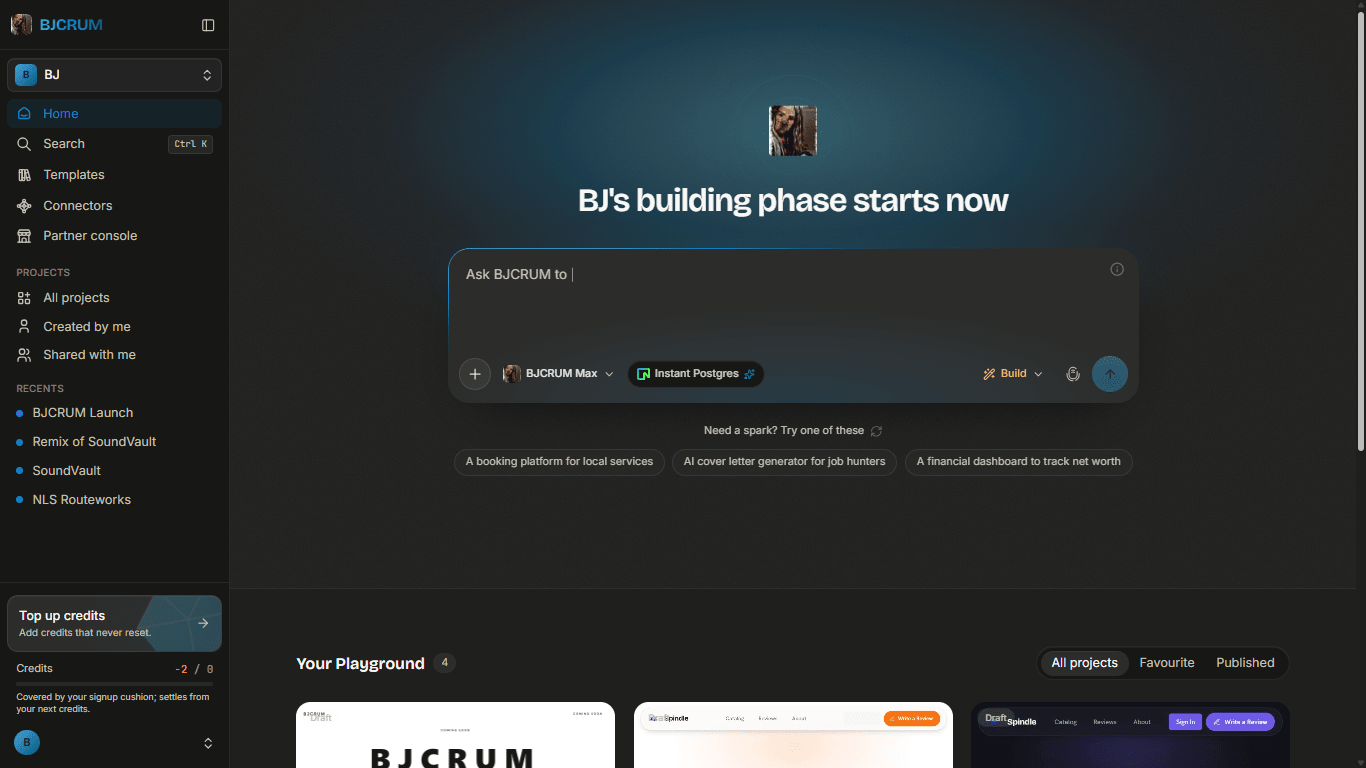
Tell BJCRUM what you want to build, and it helps you plan, design, build, refine, and publish your product.
Think of BJCRUM as an AI-powered product team, available whenever you're ready to build.
What can you build with BJCRUM?
BJCRUM can build much more than simple landing pages. You can use it to create:
- Business websites and landing pages
- SaaS applications
- Dashboards and admin panels
- CRM systems
- Client portals
- Marketplaces
- Booking and scheduling applications
- Membership platforms
- Internal business tools
- AI-powered applications
- Custom web applications
Whether you're launching your own product or building for a client, you can take an idea from a simple prompt to a working application inside BJCRUM.
How BJCRUM works
Building starts with a prompt. For example:
Build a world-class construction website. The website should have all the navigations a construction website should have. Use professional and very clean images.
From there, BJCRUM can analyze your request, plan the product, create the interface and functionality, and give you a working application you can continue refining through conversation.
The basic workflow is:
Describe
Tell BJCRUM what you want to build in plain language. You don't need to write a technical specification before getting started.
Plan
For more complex projects, BJCRUM can create and audit a product plan before writing the application. This gives you an opportunity to review the proposed structure and requirements before building.
Build
BJCRUM turns the requirements into a working product, creating the necessary pages, components, functionality, and application logic.
Refine
Continue talking to BJCRUM to make changes. For example:
> Add a testimonials section to the homepage.

or:

> Create an admin dashboard where I can manage customer enquiries.

BJCRUM works with the existing project rather than requiring you to start over.
Publish
When you're ready, publish your project directly from BJCRUM. Your application receives a live BJCRUM URL, and supported plans can connect a custom domain.
BJCRUM is your AI product team
Building software has traditionally required a team of specialists. A typical product team includes:
- Product managers who define requirements
- Designers who create user experiences
- Frontend developers who build interfaces
- Backend developers who create functionality
- Engineers who connect systems and deploy applications
BJCRUM brings these capabilities together into one AI-powered workspace. Instead of managing multiple tools and teams, you can collaborate with BJCRUM throughout the entire product development process.
From idea to evolving product
BJCRUM doesn't just generate your first version and stop. Your application can continue evolving as your ideas change.
You can ask BJCRUM to:
- Add new features
- Improve user experiences
- Create new pages
- Connect external services
- Modify existing workflows
- Add databases and functionality
- Fix issues and refine your application
Your first prompt is only the beginning. BJCRUM helps you continuously improve your product as you learn from users and discover new opportunities.
Your application grows with you
Traditional development often requires returning to developers every time you want to make a change. With BJCRUM, your application becomes something you can continuously build on.
For example:
Day 1
Build a booking website for a fitness studio. BJCRUM creates the first version.
Day 30
Add membership subscriptions, customer profiles, and an admin dashboard. BJCRUM evolves the application.
Day 90
Add AI recommendations and automated customer follow-ups. BJCRUM continues extending the product.
Your application grows as your business grows.
Why this matters
BJCRUM is designed for the future of software development.
The future is not just generating code faster. The future is having an intelligent partner that understands your product, helps you make decisions, and accelerates every stage of building software.
Frontend and backend
BJCRUM isn't limited to generating the visual interface of your application. It can help build applications that require:
Frontend
Pages, layouts, navigation, forms, dashboards, responsive interfaces, animations, and other user-facing experiences.
Backend
Authentication, databases, APIs, application logic, data storage, and other functionality required by dynamic applications.
This allows you to build products where users can sign in, create and retrieve data, interact with dashboards, submit information, and perform real application workflows.
Connect your favorite services
BJCRUM can also build applications that work with external services. Supported connectors and integrations include services for:
- AI models
- Payments
- SMS
- File and image uploads
- Calendars and scheduling
- Databases
- Other APIs
For example, you could ask BJCRUM to build a SaaS application that accepts payments through Stripe, sends transactional emails through Resend, and uses an AI model for an AI-powered feature.
You provide the required credentials, and BJCRUM writes the application code needed to work with the service.
Build Mode and Plan Mode
BJCRUM gives you two ways to approach a project.
Build Mode
Use Build Mode when you want BJCRUM to start building immediately. This works well for straightforward projects or when you already know what you want.
Plan Mode
Use Plan Mode when you want BJCRUM to think through the product before implementation. BJCRUM creates a structured product plan that can be reviewed and refined before development begins.
Plan Mode is especially useful for larger applications with multiple pages, features, database requirements, user roles, or complex workflows.
Who is BJCRUM for?
BJCRUM is designed for both technical and non-technical builders.
Founders & Entrepreneurs
Turn product ideas into working applications and test new concepts faster.
Agencies & Freelancers
Build websites and applications for clients while dramatically reducing development time.
Developers
Use AI to accelerate development instead of manually implementing every component and workflow.
Businesses & Teams
Build internal tools, customer portals, dashboards, and custom applications around your workflows.
You remain in control
BJCRUM doesn't lock you into a completely closed development environment. Projects can be exported when you need greater control over the code or deployment.
This makes it possible to start quickly with BJCRUM while retaining the flexibility to continue working with your project outside the platform when necessary.
From idea to live product
The simplest way to understand BJCRUM is to build something. You don't need the perfect prompt.
Start by describing:
what you're building + who it's for + what it should do.
For example:
Build a CRM for a real estate agency. Agents should be able to add leads, manage properties, track deals, schedule follow-ups, and view their sales pipeline from a dashboard.

BJCRUM can take it from there.
Next: How BJCRUM Works
Now that you know what BJCRUM is, learn how the BJCRUM workflow takes your idea through prompt, plan, build, refine, and publish.
How BJCRUM Works
See the full BJCRUM workflow from prompt to published product.